RESEARCH, EXPLAINED

Starting with atoms,
explore our research.

Why does a material perform well, and how could it perform better? We seek answers at the atomic scale using theoretical calculations and artificial intelligence. This guide introduces our five research directions through papers coauthored by Yujin Ji, helping undergraduates understand the questions, foundational knowledge, and methods behind our work.

A Research Guide for Undergraduates 5 figures from published papers With figure-reading notes

Structural Evolution

ATOMIC STRUCTURE & DYNAMICS

How do atoms in materials rearrange themselves?

A material is not a static structural picture. During synthesis, heating, or use, atoms move, defects emerge, and a crystal may adopt a different arrangement. These changes affect stability, catalytic activity, and heat transport. This direction asks how structures form, why they change, and what those changes do . The work draws on structural chemistry, thermodynamics, and statistical physics. We first use density functional theory (DFT) to calculate electronic structures, energies, and atomic forces, then use molecular dynamics (MD) to follow atomic motion and compare the results with diffraction, microscopy, and other experiments. The iridium-oxide nanoribbon study shown here illustrates how precursors can evolve into a metastable crystalline phase. [1]

structural chemistry thermodynamics DFT/Molecular Dynamics

Original image of the paper · Structural evolution of nanoribbons

View full-size figure ↗
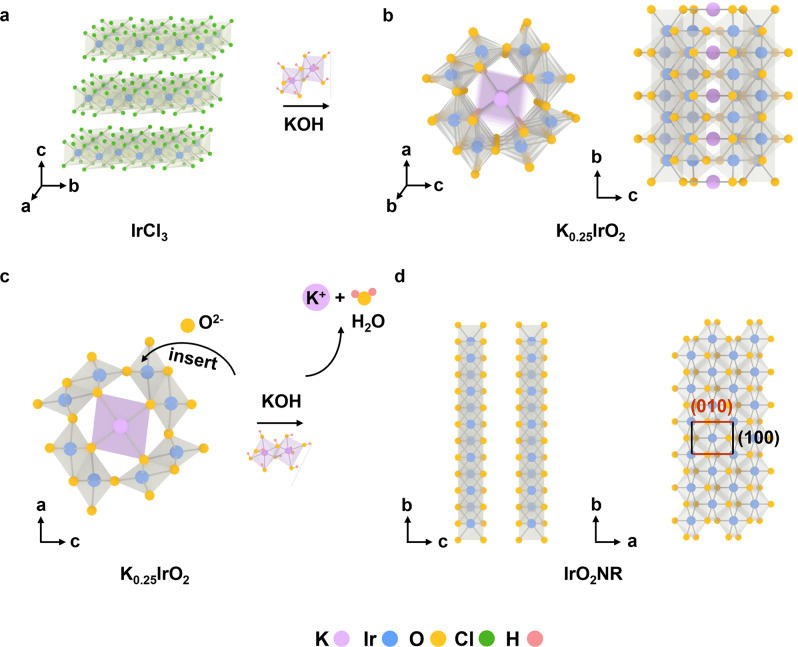
Schematic diagram of the formation of iridium oxide nanoribbons: from IrCl3 and KOH precursors, through potassium-containing intermediate structures, monoclinic phase IrO2 is formed; different colored spheres represent different elements.

How to Read the Figure Follow the arrows to see how the atomic arrangement changes and the involvement of potassium ions and water molecules. This is a schematic diagram of the formation process and structural evolution, not a molecular dynamics trajectory.

Image source: Fan Liao, Kui Yin, Yujin Ji, etc., Nature Communications (2023),Fig. 2. Paper [1] ↗
© 2023 The Author(s) · CC BY 4.0 · Original figure reproduced in full, without modification.
Surface Reaction Mechanisms

SURFACE REACTION MECHANISMS

What steps does a chemical reaction go through?

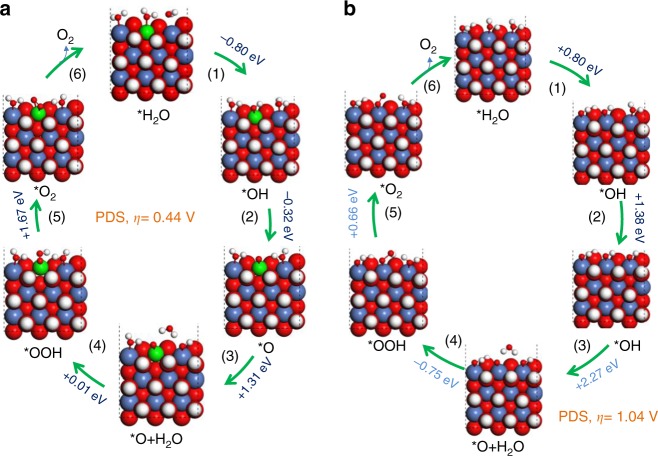
Energy processes such as water electrolysis and fuel-cell reactions often occur on catalyst surfaces. A seemingly simple overall reaction involves molecular adsorption, bond breaking and formation, and product desorption. This research seeks to identify the active sites, possible reaction pathways, and steps that limit efficiency . A foundation in physical chemistry, quantum chemistry, and electrochemistry is useful. We typically use DFT to compare adsorption structures and reaction free energies, search for transition states and calculate activation barriers where necessary, and consider solvent and electrode-potential effects. For example, the study of single tungsten atoms in nickel hydroxide explains changes in oxygen-evolution performance by comparing individual reaction steps. [2]

electrochemistry Adsorption and free energy Reaction Path/Transition State

Original image of the paper · Comparison of oxygen evolution reaction pathways

View full-size figure ↗
Oxygen-evolution reaction cycles on tungsten-doped nickel hydroxide (left) and undoped nickel hydroxide (right), showing adsorbed intermediates and the free-energy change of each step.

How to Read the Figure Compare the same reaction step left and right to observe changes in intermediates and energy. The values in the figure are the free energy changes of the steps and cannot be directly used as the activation energy barrier corresponding to the reaction speed.

Image source: Junqing Yan, Lingqiao Kong, Yujin Ji, etc., Nature Communications (2019),Fig. 5. Paper [2] ↗
© 2019 The Author(s) · CC BY 4.0 · Original figure reproduced in full, without modification.
Structure–Property Relationships

STRUCTURE–PROPERTY RELATIONSHIPS

Why does the performance change if only a few atoms are replaced?

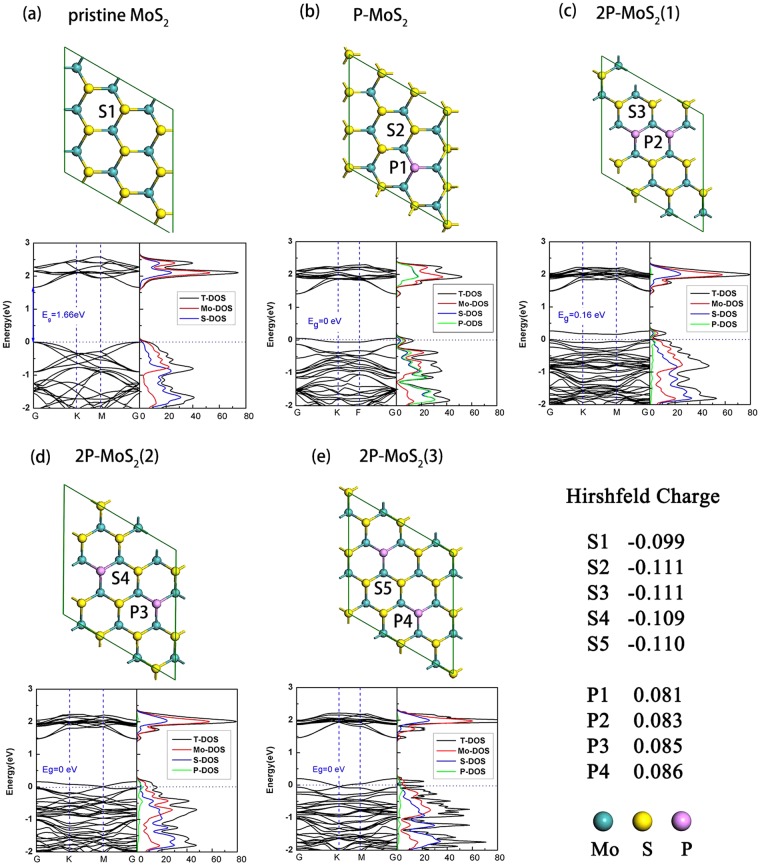
Even with similar chemical compositions, different atomic arrangements, dopant positions, and local coordination can lead to very different conductivity, stability, or catalytic behavior. Structure–property research connects what changed in the structure with why the properties changed , seeking principles that can guide materials design. This requires structural chemistry, quantum mechanics, and data analysis. We compare band structures, densities of states, and charge distributions using DFT, then combine these results with adsorption and reaction calculations to identify the structural features that control performance. For phosphorus-doped MoS2, for example, we can vary the number and positions of phosphorus atoms, follow the resulting electronic changes, and analyze their influence on oxygen-reduction activity. [3]

electronic structure Doping and local coordination Descriptors/Data Analysis

Original image of the paper · Doping and electronic structure

View full-size figure ↗
Comparison of atomic structures, band structures, projected densities of states, and charge analyses for undoped MoS2, single-phosphorus doping, and different two-phosphorus doping configurations.

How to Read the Figure First look at the atomic positions above each group, and then compare the band structure and density of states below. They describe changes in electronic states; to judge the catalytic effect, it needs to be combined with subsequent reaction calculations.

Image source: Cheng Liu, Huilong Dong, Yujin Ji, etc., Scientific Reports (2018),Fig. 1. Paper [3] ↗
© 2018 The Author(s) · CC BY 4.0 · Original figure reproduced in full, without modification.
High-throughput Materials Screening

HIGH-THROUGHPUT MATERIALS SCREENING

There are thousands of candidates, which one should be studied first?

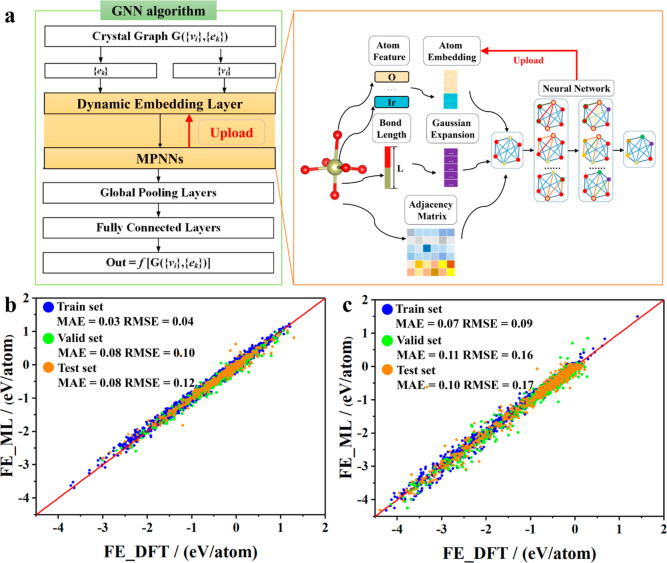
Varying elemental composition, crystal structure, and doping strategy rapidly expands the number of candidate materials. High-throughput screening uses consistent, reproducible workflows to identify candidates that merit further study . Alongside materials science and quantum chemistry, the work uses Python, Linux, automated task management, and statistical analysis: building structures in batches, calculating stability and target properties, and screening against explicit criteria. In the CrystalGNN study coauthored by Yujin Ji, crystals are represented as graphs of atoms and their relationships. The model learns patterns in DFT data and accelerates the search for metastable IrO2 structures. [4]

Python/Automation Materials Databases Graph Neural Networks

Original image of the paper · CrystalGNN model

View full-size figure ↗
CrystalGNN feeds atoms, distances, and adjacencies into a graph neural network; the scatter plot below compares machine learning predictions and DFT results for the formation energies of 2D and bulk materials.

How to Read the Figure Above is the calculation process of "Crystal Structure → Graph Network → Properties". The closer the lower scatter points are to the diagonal, the more consistent the predictions are with DFT; this does not guarantee that the model will be equally accurate for all unknown materials.

Source: Jie Feng, Zhihao Dong, Yujin Ji, Youyong Li, JACS Au (2023),Fig. 1. Paper [4] ↗
© 2023 The Authors · CC BY-NC-ND 4.0 · Original figure reproduced in full, without modification.

Materials Design & Optimization

MATERIALS DESIGN & OPTIMIZATION

Can we design the structure from the target performance in reverse?

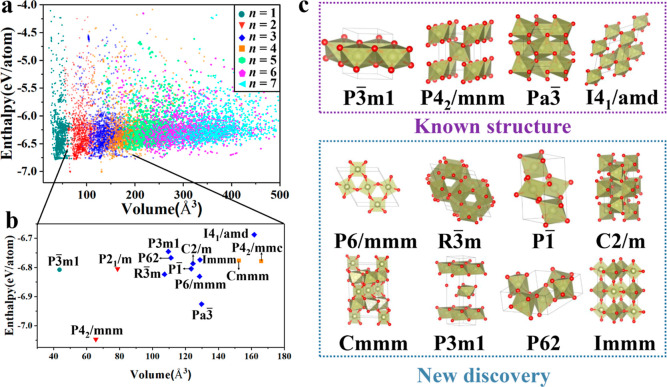
Understanding these relationships also allows us to propose new structures: changing crystal phases, dopants, strain, or interfaces to seek better catalysts and energy materials. Starting from the target properties, this research aims to balance activity, stability, and synthetic feasibility . We combine chemical intuition, crystallography, thermodynamics, and optimization, repeatedly evaluating candidates through structure searches, accurate DFT calculations, and surface-reaction analysis. CrystalGNN identified new metastable structures among many IrO2 configurations and evaluated their oxygen-evolution potential, illustrating a propose–predict–validate design process. Computational discoveries still require experimental testing. [4]

Crystal Structure Search multi-objective optimization Comparison of theory and experiment

Original image of the paper·Discovery of metastable crystalline phases

View full-size figure ↗
Enthalpy versus volume scatter plots, enlargements of low-enthalpy regions, and atomic structures of known and newly predicted crystal phases for a number of IrO2 candidate structures.

How to Read the Figure Each scatter point corresponds to a computational candidate structure. Search from a wide range into a low-enthalpy region, and then observe the selected crystal phase; low enthalpy itself cannot prove good catalytic activity, or it can definitely be prepared in experiments.

Source: Jie Feng, Zhihao Dong, Yujin Ji, Youyong Li, JACS Au (2023),Fig. 3. Paper [4] ↗
© 2023 The Authors · CC BY-NC-ND 4.0 · Original figure reproduced in full, without modification.

AI × COMPUTATIONAL CHEMISTRY

Extending what we can compute,
with evidence behind every prediction.

Artificial intelligence is expanding the tools of computational chemistry and materials science: learning structure–property relationships, modeling interatomic interactions, and proposing candidate structures. The following three studies, coauthored by Yujin Ji, illustrate these developments.

GRAPH NEURAL NETWORKS / 2023

Learning Properties from Structure

CrystalGNN constructs features directly from atoms and their geometric relationships, reducing reliance on manually chosen descriptors. The study used it to predict the energies of many IrO2 configurations and identify promising metastable phases for further calculation. [4]

DEEP POTENTIAL / 2025

Extending Atomistic Simulations

Deep-potential models learn energies and atomic forces from DFT data, reducing the cost of each step of a molecular-dynamics simulation. In the CsPbBr3 study, this approach was used to investigate relationships between vacancies, lattice distortions, and heat transport. [5]

TRANSFORMERS / PERSPECTIVE

From Prediction to Structure Generation

The review discusses progress and prospects for Transformers in chemical-property prediction, structure generation, and related tasks. These tools expand data-driven research while requiring careful evaluation of data quality, applicability, and physical plausibility. [6]

  1. 01 Define the physical question Define the material, environment, and target property
  2. 02 Build a reliable dataset Obtain data from quantum calculations or experiments
  3. 03 Train and evaluate AI Predict, rank, and assess errors
  4. 04 Validate and refine Validate with accurate calculations and experiments, then expand the data

A foundation in chemistry and physics helps you ask meaningful questions; programming and machine learning help you investigate them efficiently. Undergraduates should develop both sets of skills together.

A SMALL READING GUIDE

You do not need to know every term
to begin with a question.

Choose a direction that interests you, understand the question it addresses, and then explore the figures and paper abstracts. Physical chemistry, structural chemistry, and basic data processing in Python provide a useful foundation for getting started.

DFT · density functional theory

A widely used quantum-mechanical method that starts from electron density to calculate a system's energy and electronic structure. It can compare structural stability, calculate forces, and analyze reactions, but results depend on the chosen model and approximations.

MD · Molecular Dynamics

Molecular dynamics computes atomic motion step by step from interatomic interactions. It lets us investigate structural changes and transport at finite temperatures. The accessible system size and simulation duration depend on the model and computational cost.

GNN · Graph Neural Network

A graph neural network treats atoms as nodes and relationships such as neighboring connections as edges. Information passes through the graph to learn structural features. This representation suits molecules and crystals and is often used to predict energies or other material properties.

What is the difference between reaction free energy and activation energy barrier?

Reaction free energy compares the thermodynamic states at the beginning and end of a step. An activation barrier describes the energy needed to cross a transition state. The former indicates thermodynamic driving force; the latter is related to reaction rate. They are different quantities.

READ THE ORIGINAL RESEARCH

Explore the original research.

Yujin Ji is a coauthor of every paper listed below. The figures come from the first four papers; the final two illustrate applications and developments in artificial intelligence.

  1. [1]

    Iridium oxide nanoribbons with metastable monoclinic phase for highly efficient electrocatalytic oxygen evolution

    Fan Liao, Kui Yin, Yujin Ji et al.

    Nature Communications 14, 1248 (2023) · Fig. 2

  2. [2]

    Single atom tungsten doped ultrathin α-Ni(OH)₂ for enhanced electrocatalytic water oxidation

    Junqing Yan, Lingqiao Kong, Yujin Ji et al.

    Nature Communications 10, 2149 (2019) · Fig. 5

  3. [3]

    Origin of the catalytic activity of phosphorus doped MoS₂ for oxygen reduction reaction (ORR) in alkaline solution: a theoretical study

    Cheng Liu, Huilong Dong, Yujin Ji, Tingjun Hou, Youyong Li

    Scientific Reports 8, 13292 (2018) · Fig. 1

  4. [4]

    Accelerating the Discovery of Metastable IrO₂ for the Oxygen Evolution Reaction by the Self-Learning-Input Graph Neural Network

    Jie Feng, Zhihao Dong, Yujin Ji, Youyong Li

    JACS Au 3, 1131–1140 (2023) · Figs. 1 & 3

  5. [5]

    Effect of Cs vacancy on thermal conductivity in CsPbBr₃ perovskites unveiled by deep potential molecular dynamics

    Shuhao Han, Yujin Ji, Youyong Li

    Nanoscale 17, 6793–6803 (2025) · DOI: 10.1039/D4NR05458J

  6. [6]

    Applications of Transformers in Computational Chemistry: Recent Progress and Prospects

    Rui Wang, Yujin Ji, Youyong Li, Shuit-Tong Lee

    The Journal of Physical Chemistry Letters 16, 421–434 (2025) · DOI: 10.1021/acs.jpclett.4c03128

Figures are reproduced in full from open-access versions of the papers. Authors, figure numbers, and licenses are credited below each figure. Figures licensed under CC BY-NC-ND are used for this site's noncommercial academic introduction; further reuse must comply with the original license. The introductions and figure-reading notes were prepared for this website. Consult the original papers for the precise models, conditions, and conclusions. Sources checked: September 2026.

Turn your interest into a research question.

Contact the Group